
Ohio’s ‘wandering bears’ signal a possible comeback for the species
Researchers ask for help tracking black bears that appear to have moved into eastern Ohio from West Virginia and Pennsylvania
COSHOCTON – On a warm night in mid July, Brandan Smith heard a sound outside his house in rural Coshocton. Curious, he opened his door and walked outside. As his eyes adjusted to the dark, he saw a large, hulking figure in his driveway, rummaging in the bins and boxes he’d readied for trash pickup the next day.
“I immediately turned around, went back inside the house and slammed the door,” Smith recalled. “That image of something huge spooked me. And it just kind of dawned on me: It’s a bear.”
Certain that no one would believe him unless he had proof, Smith grabbed his phone, gathered his courage and went back outside to capture a video.
“Sure enough, the bear was still there, eating garbage,” Smith said. “I’d just gotten done cleaning out the deep freezer, and it was into the old freezer-burned ice cream.”
According to Smith, the bear seemed completely unbothered by his presence, even though he was only about 25 feet away. Unsure what to do, Smith called the police. Then he watched the bear ransack his trash pile until a police cruiser arrived half an hour later and scared it off with a spotlight.
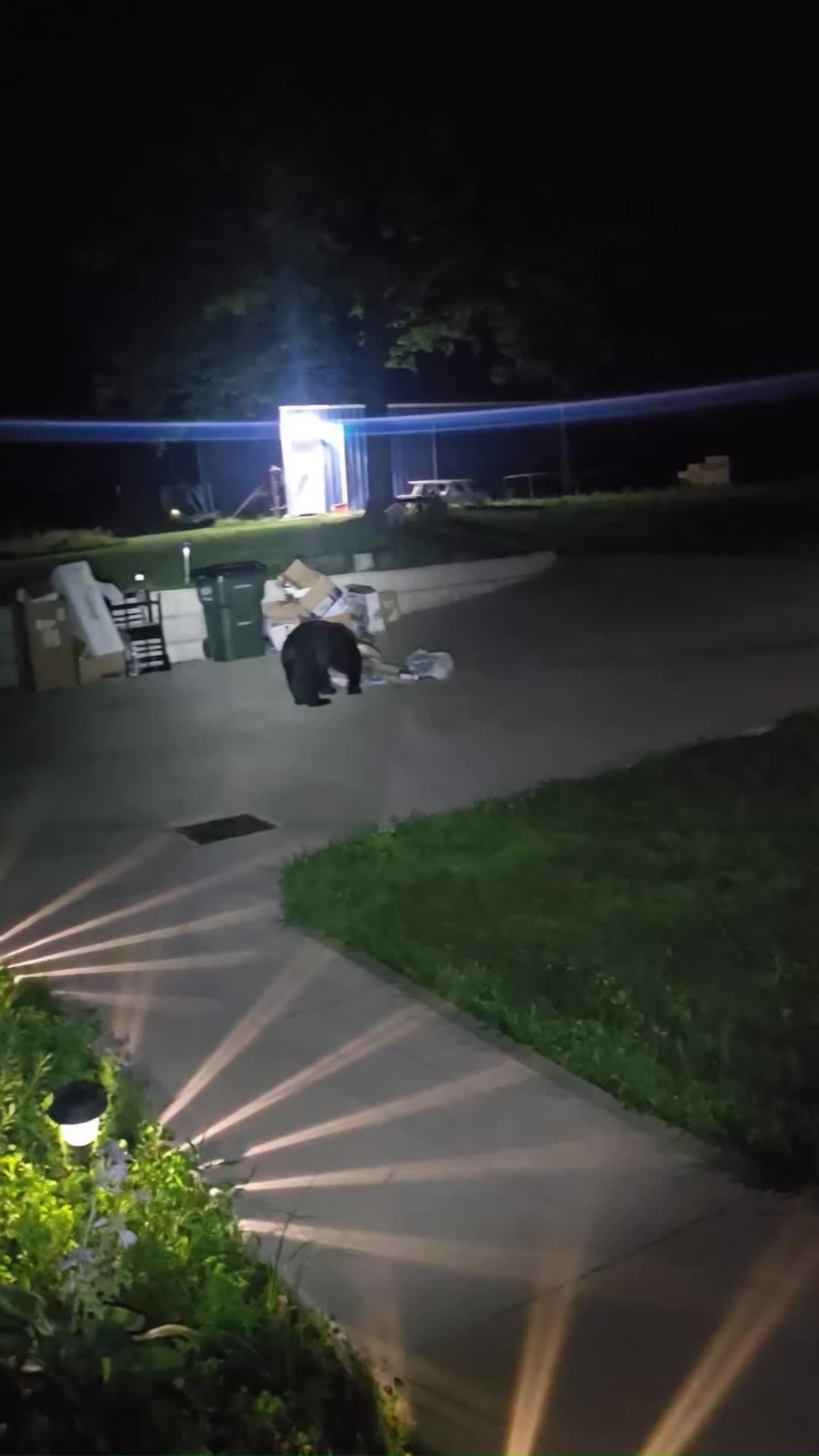
Brandan Smith recorded this cell phone video after discovering a black bear outside his home in Coshocton County.
Brandan Smith recorded this cell phone video after discovering a black bear outside his home in Coshocton County.
After virtually disappearing from the Ohio landscape in the mid-1800s, black bears could be making a comeback. More than 1,500 bear sightings have been reported to the Ohio Department of Natural Resources (ODNR) since 2022. While the majority have been spotted in rural areas near Ohio’s borders with West Virginia and Pennsylvania, black bears have been seen in 69 of Ohio’s 88 counties, and some have wandered into more populated areas, including near Pataskala in Licking County in 2025.
According to the Ohio Division of Wildlife’s 2026 Ohio Black Bear Monitoring Report, the number of confirmed black bear sightings gradually rose in the 1990s and 2000s, plateaued during the 2010s, then sharply increased starting in 2022.
“On average, over the past 10 years the Division of Wildlife has received 239 black bear sighting reports per year,” the report stated. “In 2023, 260 sightings were reported in 49 counties. In 2024 we received 370 sightings in 55 counties. Sightings were the highest on record in 2025 with 537 sightings in 69 counties.”
And based on local accounts, bear sightings are likely under-reported. Anyone who sees a bear can report it to the division of wildlife via ODNR’s online Wildlife Reporting System or by calling 1-800-WILDLIFE (945-3543).
ODNR advises people who encounter bears not to approach them. If you see a black bear, remain calm and slowly back away. Do not run or climb trees, which can trigger a bear’s instinct to chase. If a bear approaches, try to look large by lifting your arms, and clap or shout to scare the bear.
Black bear sightings in Ohio from 1993 to 2025. Courtesy of the Ohio Department of Natural Resources Division of Wildlife.
Black bear sightings in Ohio from 1993 to 2025. Courtesy of the Ohio Department of Natural Resources Division of Wildlife.
A brief history of black bears in ohio
Before the arrival of early American settlers, black bears were common in Ohio. But in the early 1800s, the state’s newly arrived residents began aggressively felling forests to make way for farms and settlements. They also trapped and killed bears that preyed on their crops and livestock. The arrival of the timber, iron and coal-mining industries only accelerated the destruction of the woodlands where black bears resided.
In 1803, forests covered about 95% of the state of Ohio. By 1900, only 10% of the state was wooded—but by then, the bears had been gone for half a century. Habitat loss and unregulated hunting had driven black bears from a region they had populated for millennia – the same fate faced by other large mammals in Ohio, including bison, elk, cougars and wolves.
Starting in the 1930s, occasional reports of black bear sightings began surfacing in Ohio, according to the ODNR Division of Wildlife. Reports became more regular in the 1990s, and the division of wildlife began tracking black bear observations across the state in 1993. The division soon collected enough evidence of bear activity that the state of Ohio changed the status of the species from “extirpated” to “endangered” in 1995.
Bear sightings gradually increased over the following decades and appeared to level out in the 2010s. Then, in the 2020s, the division of wildlife recorded a notable uptick in bear sightings. Of the 4,793 bear sightings the division recorded since it began collecting data in 1993, nearly a third occurred between 2022 and 2025.
Sightings in Coshocton County
Brandan Smith wasn’t the only resident of east-central Ohio’s Coshocton County to see a bear in recent months. A day or two after the police scared the bear from his property – and more than 10 miles east, near the Village of Fresno – Erica Gray was planting a pollinator garden beside her pond when she looked up and saw a “big, dark object.”
A bear with a white marking on its chest was resting on the hillside near her mother’s cabin. The bear eventually left but later returned to her mother’s bird feeder to lap up the grape jelly inside – a delicacy intended to attract Baltimore orioles, not bears.
Erica Gray said she "couldn't believe it" when she spotted a bear on the Fresno, Ohio, property where her family and her mother both reside. Image courtesty of Erica Gray
Erica Gray said she "couldn't believe it" when she spotted a bear on the Fresno, Ohio, property where her family and her mother both reside. Image courtesty of Erica Gray
In mid August, Erin Peoples, the principal of West Elementary School in nearby Newcomerstown, was preparing for the start of the school year when she received a message from her husband. He’d just received a notification from their Ring camera, a doorbell that doubles as a home security device. The attached video showed a black bear meandering onto their porch and peering through a window into their house.
“I immediately texted my daughters – they’re teenagers – and was like, ‘Stay inside,’” Peoples said.
After viewing the video, one of Peoples’ daughters shot back a skeptical text: “Is that AI?”
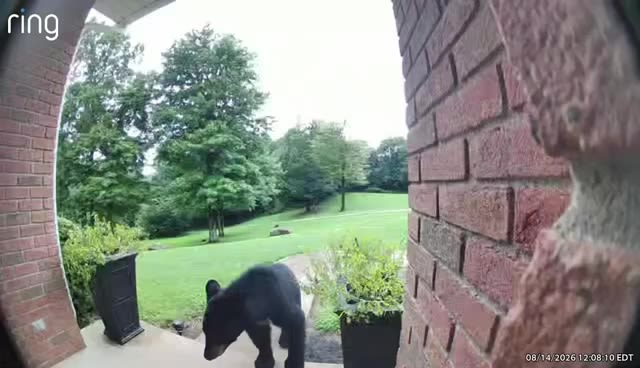
Erin Peoples' doorbell Ring camera caught this footage of a black bear on her front portch.
Erin Peoples' doorbell Ring camera caught this footage of a black bear on her front portch.
On the last Sunday in August, Carla Miller and her husband were pulling into the parking lot of the Wooly Pig Farm Brewery near the Village of Fresno, when she noticed a bear walking along the fence line inside the pig pasture.
“I said, ‘Oh my gosh, there’s a bear,’” Miller recalled. “And my husband of course ignored me. And I said, ‘Stop! I want to take a picture!’”
Miller said that a small crowd gathered to watch the bear, which “was not scared of people at all.” Even after several “momma pigs” ran the bear off, it returned and “just sat up there eating those pokeberries.”
Carla Miller of West Lafayette, Ohio, spotted a black bear in the pig pasture at the Wooly Pig Farm Brewery. Image courtesy of Carla Miller
Carla Miller of West Lafayette, Ohio, spotted a black bear in the pig pasture at the Wooly Pig Farm Brewery. Image courtesy of Carla Miller
On Oct. 3, Don Dunlap was fishing about two miles from Wills Creek Dam in western Coshocton County – part of more than 3,700 acres of public land and water used for flood control, hunting, fishing, and recreation.
“I was out there fishing and just happened to look up,” Dunlap said. “[A black bear] stopped 50 yards from me and was looking dead at me. He was coming up that backwater, probably getting fish.”
When the bear disappeared into the woods, Dunlap – a raccoon hunter who knows the area well – hopped in his truck and intercepted the bear on a nearby road so that he could capture a video. He and his wife returned to the area later that day to take pictures of tracks the bear left in the mud.
According to the division of wildlife, Coshocton County had one confirmed bear sighting in 2023, one confirmed bear sighting in 2024, and 11 confirmed bear sightings in 2025. While data is not yet available for 2026, The Reporting Project collected 24 accounts of bear sightings in the county between May 2026 and November 2026. It was able to confirm 16 of those accounts with photo or video evidence.
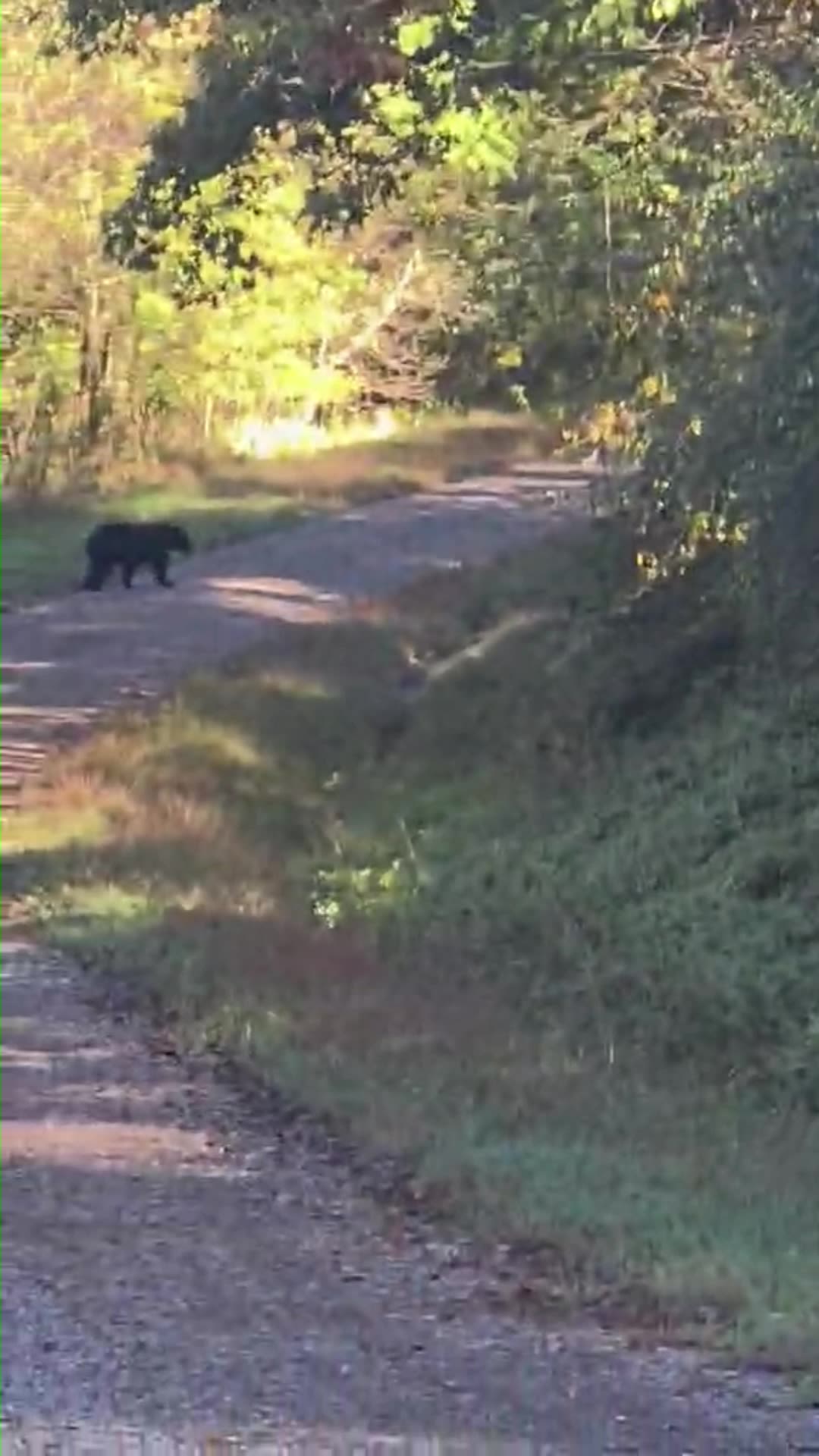
Don Dunlap used his cell phone to record this video of a bear that he encountered near Wills Creek.
Don Dunlap used his cell phone to record this video of a bear that he encountered near Wills Creek.
After seeing a bear near Wills Creek Dam, Don Dunlap's returned with his wife and found bear tracks in the mud. Photo courtesy of Kelly Ghaligher-Dunlap
After seeing a bear near Wills Creek Dam, Don Dunlap's returned with his wife and found bear tracks in the mud. Photo courtesy of Kelly Ghaligher-Dunlap
Why bears are wandering into Ohio
According to ODNR Wildlife Biologist Katie Dennison, “West Virginia and Pennsylvania have seen a lot of growth in their bear populations. That means the bears are starting to naturally expand to Ohio.”
Still, increased bear sightings do not necessarily mean that bears are settling in Ohio. The division of wildlife’s 2026 Ohio Black Bear Monitoring Report explains that most of the bears in Ohio are “dispersing or transient males” that “likely do not stay in the state for long.”
Mariela Gantchoff, a wildlife ecologist and an assistant professor of biology at the University of Dayton, has been studying recolonizing bear populations for the last 13 years. She explained that male bears tend to be the first to venture into new territory. Unlike female bears, who often establish home ranges close to their mothers, male bears are forced to leave their mothers’ territories when they are about 2 years old. This prevents inbreeding and helps them avoid competition with older, more established males.
“So that’s why when people say ‘wandering bear,’ it’s typically a young male that has no idea what he’s doing, doesn’t know where it’s going – it’s just trying its best,” Gantchoff said. “But it’s really rough, and they usually have pretty high mortality.”
Gantchoff confirmed that many of the bears in Ohio are “wandering bears.” Young males may roam through an area for a few weeks and then leave. They might travel between Ohio and other states. It’s not unheard of, she said, for bears to swim back and forth across the Ohio River. But without the presence of potential mates, they will not establish a home range.
Courtesy of the Ohio Department of Natural Resources Division of Wildlife
Courtesy of the Ohio Department of Natural Resources Division of Wildlife
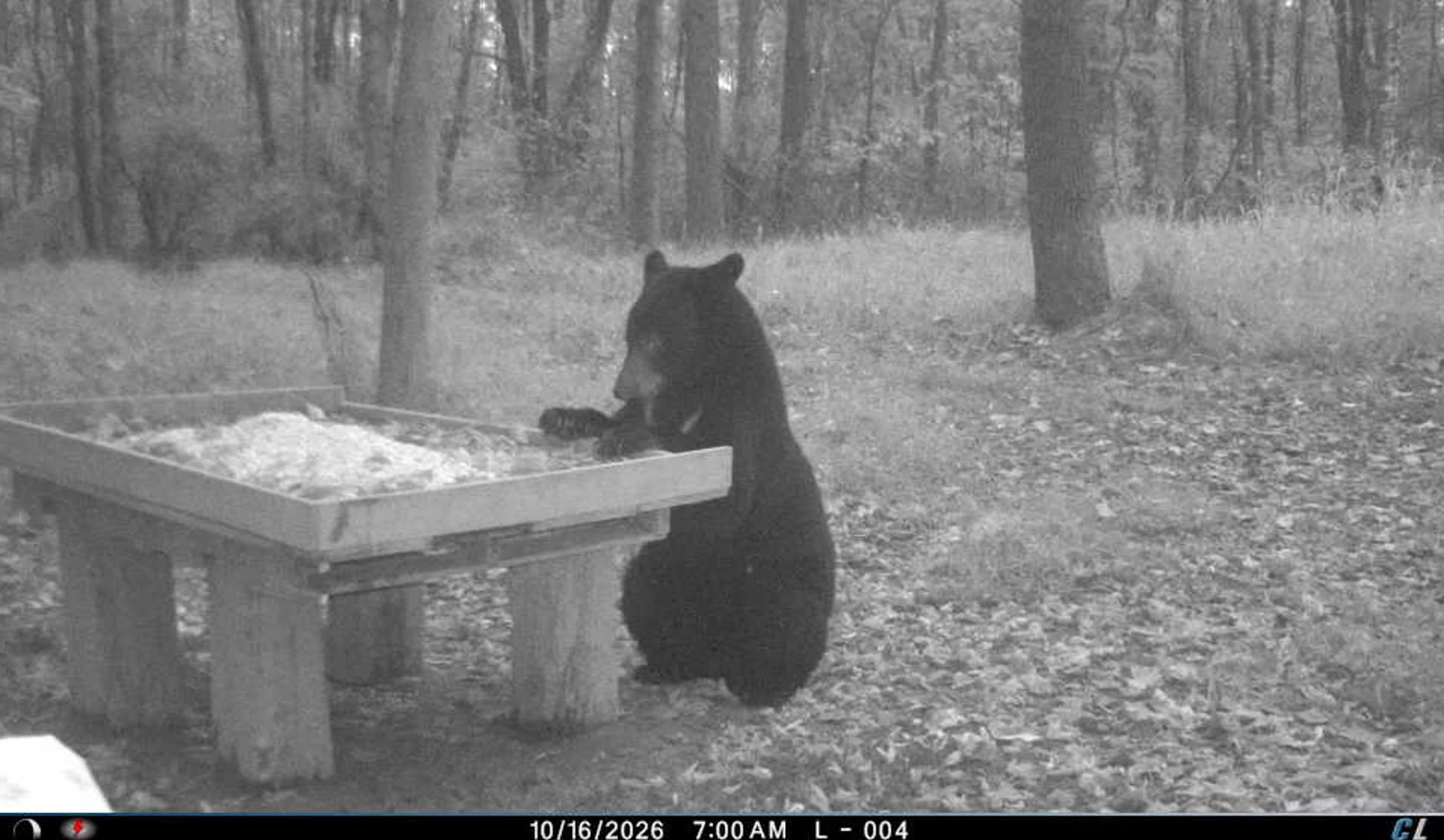
A trail camera captured these photos of a bear near Fresno, Ohio on Oct. 16, 2026. Images courtesy of Levi Stutzman
A trail camera captured these photos of a bear near Fresno, Ohio on Oct. 16, 2026. Images courtesy of Levi Stutzman
A rise in sightings: more cameras or more bears?
Experts have several explanations for Ohio’s recent uptick in bear sightings.
Gantchoff pointed out that cellphones, trail cameras and Ring cameras have become widespread.
“We have cameras out there getting evidence of things that maybe before you would have never known,” she explained.
This was almost certainly the case for the recent string of bear sightings in Coshocton County, according to Dennison. While she felt confident that there were at least two bears in the county, she’d traced the majority of those sightings to a single bear – a young male with a white, v-shaped marking on its chest.
“We have some bears that fly under the radar,” Dennison said. “This bear? Everybody saw him. He was having a good time in everybody’s yard.”
While technology makes documenting and reporting bear encounters easier, it’s not the only reason for the jump in sightings over the last few years, according to Dennison.
“I do think there’s some growth happening – and we have had evidence of reproduction, or at least evidence of females,” Dennison explained.
The 2026 Ohio Black Bear Monitoring Report said that in the northeastern corner of the state, which has by far the greatest number of reported sightings, there has been “consistent evidence of reproducing female bears.” In all but one year since 2016, there has been a confirmed sighting of a sow with cubs in Ashtabula County. In 2023, 2024 and 2025, sows with cubs have been seen in Geauga County east of Cleveland.
Over the last decade, sows with cubs have regularly been sighted in northeast Ohio, according to Katie Dennison. Trail camera image courtesty of the Ohio Department of Natural Resources and the Gantchoff Lab, University of Dayton
Over the last decade, sows with cubs have regularly been sighted in northeast Ohio, according to Katie Dennison. Trail camera image courtesty of the Ohio Department of Natural Resources and the Gantchoff Lab, University of Dayton
There is also evidence that bears are beginning a comeback in southeastern Ohio.
“We have documented a sow and cubs a couple of times in Meigs County,” south of Athens, Dennison said.
Pairs of bears believed to be mates – or potential mates – have been spotted in Washington County and Hocking County, according to Dennison.
She added that in September, “We got the first sighting of two bears – we’re pretty sure it’s a female with a yearling cub in Noble County. … That, to me, is definitely indicating a change is happening.”
A sow with a cub captured by trail camera in May of this year. Image courtesty of the Ohio Department of Natural Resources and the Gantchoff Lab, University of Dayton
A sow with a cub captured by trail camera in May of this year. Image courtesty of the Ohio Department of Natural Resources and the Gantchoff Lab, University of Dayton
Staying safe in bear territory
FFor some Ohioans, the prospect of a bear comeback is a cause for concern.
Smith said that since his bear encounter, he has worried about the safety of his 11-year-old daughter and her friends. He has strategically placed bear spray and air horns at various places on his property, just in case.
Smith added that before his bear encounter, he would have had no problem walking up and down his road at night.
“Now, I wouldn’t go without a spray or a horn,” he said. “I wouldn’t go at all unless I had to.”
Bear pepper spray is a deterrant that can be used to ward off a bear behaving aggressively. Some evidence suggests that bear spray may not be effective against bears that are conditioned to human food and garbage. Image courtesy of Wikimedia Commons
Bear pepper spray is a deterrant that can be used to ward off a bear behaving aggressively. Some evidence suggests that bear spray may not be effective against bears that are conditioned to human food and garbage. Image courtesy of Wikimedia Commons
Black bears tend to be fearful of people, which means that they are unlikely to attack, but they are large, wild animals that can weigh up to 400 pounds and are capable of seriously injuring and even killing humans, especially if they feel that their food, territory or cubs are threatened.
Records show that no humans have been killed by wild black bears in Ohio. However, in 2016, an 18-year-old woman reported being attacked by a 100-pound black bear while camping near Atwood Lake in Carroll County. According to news reports, the woman sustained a cut on her arm.
Jarred Allison, ODNR’s Wildlife Officer for Coshocton County, emphasized that black bears are not “going to stalk and eat a person.”
According to Allison, kids and pets are typically going to be safe if “they’re out making noise and playing – those are going to let any animal know you’re there.”
“The issue is when you surprise them,” Allison said. “That’s when you could potentially run into a situation.”
This might explain an encounter that Coshocton County resident Mark Price and his dogs had in late September. Price and his two golden retrievers were hiking in the woods on his property north of Dresden, when his dog Charlie took off and crossed onto his neighbor’s property.
“All of the sudden, I heard this pretty loud growl,” Price said. “A moment after that, my dog started yelping pretty loud. I feared the worst. I thought he was a goner.”
He was relieved when Charlie returned a few moments later with only a laceration and a puncture wound on his muzzle.
“What else could it have been but a bear paw slapping at him?” Price asked.
Bears looking for an easy meal may seek out bird and deer feeders, garbage bins, and even gardens, as was the case for one Fresno, Ohio family that had a black bear visit their watermelon patch. Experts recommend removing potential food sources if a bear is known to be in the area. Credit: Lucy Bryan
Bears looking for an easy meal may seek out bird and deer feeders, garbage bins, and even gardens, as was the case for one Fresno, Ohio family that had a black bear visit their watermelon patch. Experts recommend removing potential food sources if a bear is known to be in the area. Credit: Lucy Bryan
Dennison pointed out that bears are omnivores that mostly feed on plants.
“Attacks on people are incredibly rare,” Dennison said. “What does increase the likelihood is if a bear becomes habituated.”
Habituation is the process of a bear becoming so used to humans that it no longer perceives them as a threat. This often occurs in conjunction with “food conditioning,” when a bear comes to associate human-inhabited areas with available food.
“If a bear is in your area and staying in your area, try to remove those food sources,” Dennison said.
Allison recommended keeping trash cans in a protected area until the day of pickup and in taking bird feeders and deer feeders down in the summertime, when bears are most active. For beekeepers, it might be necessary to put up an electric fence if a bear is in the area.
“If you’re having a problem – if there’s a bear around and you think it’s a safety concern – reach out to your local wildlife officer or district office,” Dennison said.
Good news and a request for help
Gantchoff, the University of Dayton researcher who partnered with ODNR in 2024 to study Ohio’s bears, sees the potential for a bear comeback as part of a much bigger story – one that began more than two centuries ago with the clear-cutting of Ohio’s forests.
“There’s been some reforestation efforts, particularly in the last 50 years or so,” she explained. “Of course, that forest is not the same as pristine forest, right? It’s recovering, young forest. The fact that now we can have bears back, and the forest can support a big animal, like a bear – it’s a sign of a healthy recovery. It’s good news … because you can’t have healthy people without healthy ecosystems.”
Gantchoff stressed that there’s still a lot we don’t know about Ohio’s bears, which are still considered an endangered species in the state. It is particularly difficult to know whether a bear has established residency or is simply passing through. She and her research team have begun putting satellite GPS collars on bears to track their movements. They have collared eight black bears in Ohio since 2024 and are currently monitoring five—three males and two females.
Mariela Gantchoff and Tory Westall prepare to remove a sedated bear from a culvert trap. Image courtesty of the Ohio Department of Natural Resources and the Gantchoff Lab, University of Dayton
Mariela Gantchoff and Tory Westall prepare to remove a sedated bear from a culvert trap. Image courtesty of the Ohio Department of Natural Resources and the Gantchoff Lab, University of Dayton
Gantchoff and her research team are also soliciting help from Ohio residents who have seen bears or signs of bears in their areas. Anyone who has seen or recorded a bear, suspects property damage by a bear, or has found bear scat (poop) or tracks should submit a report via ODNR’s Wildlife Reporting System, even if the sighting happened weeks, months, or years ago. Submitters have the option to upload photos or video, if available.
People who find bear scat can put it in a Ziploc bag and freeze it – and a researcher from Gantchoff’s team will come get it. Bear scat can be tubular (like human excrement) or appear in a mound (like cow manure). Like the scat of raccoons and coyotes, bear scat may contain seeds, digested vegetation, hair, insect parts, or bone fragments. But it can be differentiated from the scat of other omnivores by its large size. The typical scat weighs more than half a pound and measures 5 to 12 inches in length.
“Poop is amazing,” Gantchoff said. “You can get so much information from it – hormones, genetics, diet.”
Coshocton County resident Stuart Clark found this bear scat near Wills Creek Dam in fall 2025. Image courtesy of Stuart Clark
Coshocton County resident Stuart Clark found this bear scat near Wills Creek Dam in fall 2025. Image courtesy of Stuart Clark
Because the majority of Ohio is private property, Gantchoff’s team is also seeking partnerships with landowners who have bear activity on their properties. Willing landowners can have “hair snares” set up to capture bear fur, which enables researchers to track bears by their DNA. They also can have a “dog survey” done, in which trained dogs find bear scat on their properties. Researchers also can trap and collar bears with the permission of property owners.
“We are working hard to better know the bears and help them persist,” Gantchoff said.
Any property owners interested in contributing to bear research in Ohio should contact Tory Westall, a graduate researcher who leads field work for Gantchoff, at westallt1@udayton.edu.
A black bear crosses a road in Coshocton County's Progressive Valley in mid October. Image courtesy of Steve Storm
A black bear crosses a road in Coshocton County's Progressive Valley in mid October. Image courtesy of Steve Storm
As winter approaches and black bears begin retreating to the dens where they will pass the coldest months of the year, sightings are sure to decrease across Ohio. But many people in Coshocton County continue to circulate pictures and share stories of their bear encounters.
“It really did my heart good to see one up close,” Don Dunlap recalled.
A decade or two ago, coming across a bear in its natural habitat that might have been considered a once-in-a-lifetime experience for an Ohioan. But if bears continue to expand into Ohio, and Dunlap continues passing time in the woods, he can hold out hope that he’ll cross paths with another black bear.
Editor's note: The Wooly Pig Farm Brewery is co-owned by Bryan's sister-in-law.
 Built with Shorthand